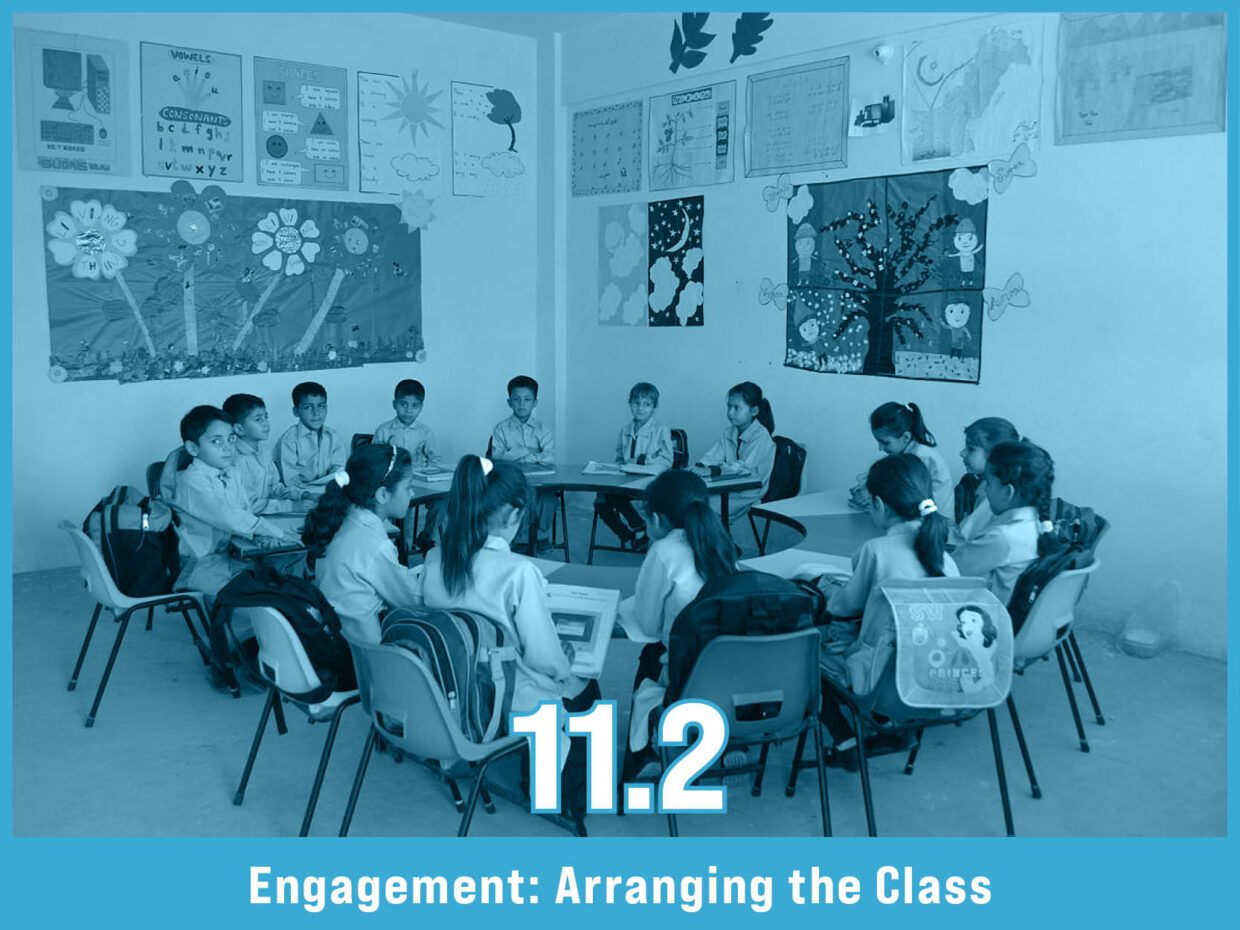
11.2 | Engagement: Arranging the Class
Preview
Before we begin, think about these questions for a moment:
- When you were a student, how often did you work individually, with a partner and in groups?
- How easy is it to change the seating arrangements in your classroom?
- Do you think your students enjoy working in pairs, groups or individually or a mixture?
Classroom Arrangement and Grouping
Students learn from their teacher, from themselves and from each other. Therefore, interaction and socialising can be very important for effective learning. During a lesson, teachers can give opportunities for learners to work together to promote interaction and socialising. There are four main ways to group students:
- Individually.
- In pairs.
- In groups.
- As a class.
Working individually allows students to work at their own pace and reflect on what they are learning. Pair and group work allows for students to share ideas with, give support to and teach each other. In general, teachers should aim to have variety within a lesson, such as by giving students at least one pair or group activity.
Pairing and grouping can happen by moving the students around the class. It can also happen by rearranging the chairs, desks and tables into different positions in a classroom. The class arrangement depends on what type of activity the students will be doing and how the classroom can be arranged. In some physical classrooms, it is very difficult or impossible to move the desks, tables or benches. When possible, teachers should be creative in arranging the classroom. For example, in larger classes, the teacher might remove the chairs and tables and put mats or rugs on the floor that students can sit on.
It can take time to change the classroom arrangement during a lesson. Therefore, teachers might want to plan and prepare the best arrangement for the class before the lesson starts. If the lessons are short, it might not be worth spending time changing the arrangement of the class during the lesson.
In online teaching, teachers can move students around virtually. In a video session or online seminar, they can move students into breakout rooms for group work. They may assign students to complete pair or group work using applications.
Teachers can try different groupings, or classroom layouts for groupings. The illustrations show six ways to group students: What are they called, and how might students be working in each (individually, in pairs, in groups or as a class)? Click below to check.
|
a.
 |
b.
 |
|
c.
 |
d.
 |
|
e.
 |
f.
 |
Click here to check what the groupings are called and how students might be working in those groupings.
Groupings:
- Rows. Students might be working individually or in pairs.
- Small workstations. Students are probably working in groups.
- Horseshoe. Students are probably working as a class.
- Free space. Students might be working individually, or might be free to mingle and work with others in pairs or groups.
- Large workstations. Students are probably working in groups.
- Circle. Students are probably working as a class.