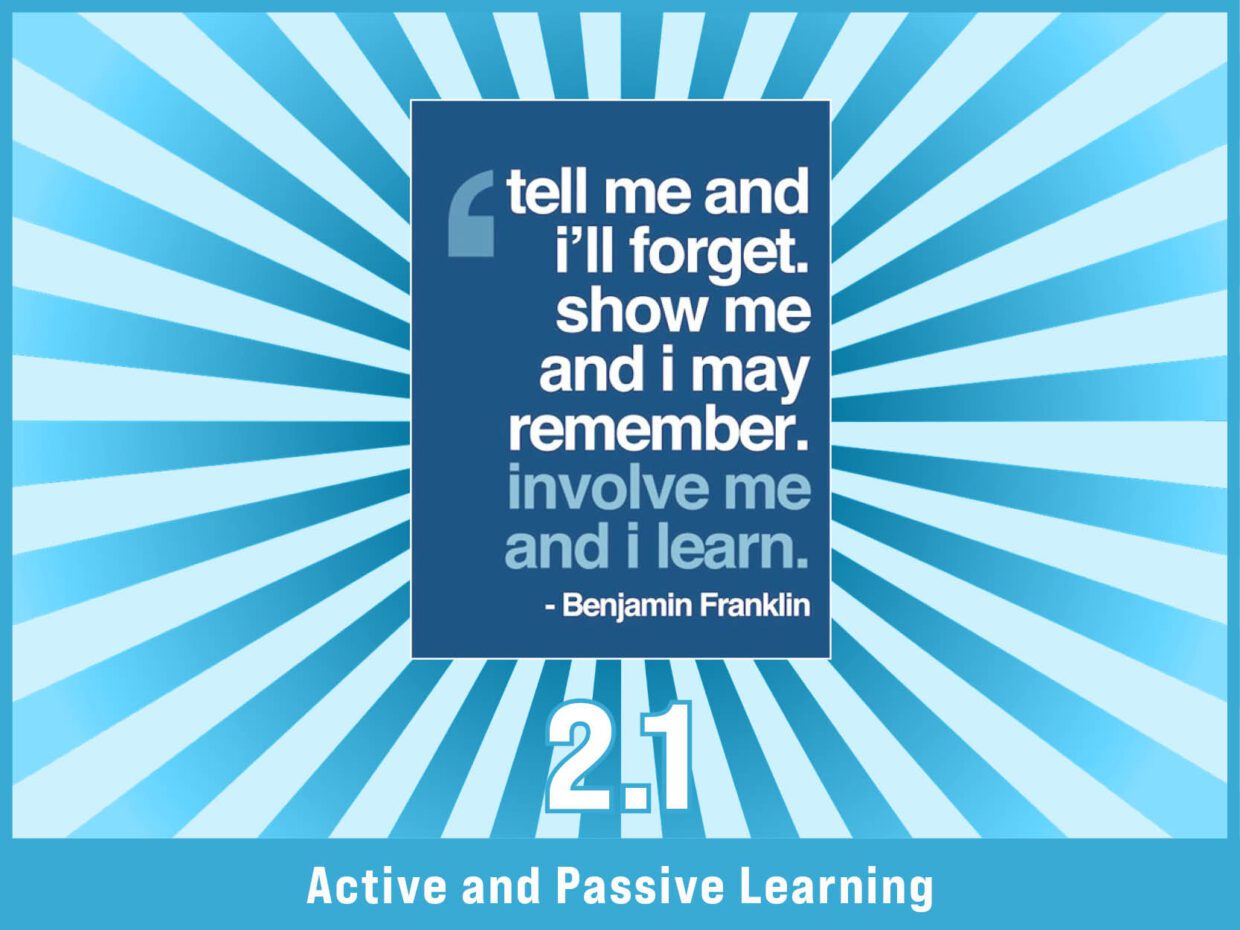
2.1 | Active and Passive Learning
Preview
Before we begin, think about the words “active” and “passive”. What do they mean to you? What kind of learning might be active, and which might be passive?
Understanding Active and Passive Learning
Learning can be divided into two categories, passive learning and active learning. Passive learning is the “passing” of knowledge from the teacher to the student. Students memorise this knowledge, usually without questioning it or reflecting on it. Knowledge is often passed on through lectures, slides or videos. The teacher is often the focus of the classroom, and students just listen. This type of learning focuses more on what the teacher is doing and less on what the students are doing. We sometimes call this teacher-centred learning (or teaching).
Active learning is acquiring knowledge and skills through discussion, projects and activities that involve the students. This usually uses interactions between the teacher and the students – the students interact with the teacher and with each other. Common forms of interaction include asking and answering questions, cooperating and collaborating and solving problems. In active learning, students share their ideas and their experiences with their teacher and their classmates. Students have the opportunity to question and reflect on what they are learning. This type of learning focuses more on what the students are doing and less on what the teacher is doing. We sometimes call this student-centred learning (or teaching).
Some classroom activities can be both active and passive, or can be made more active by the teacher. For example, if the teacher asks the students questions while they are doing a relatively passive classroom activity.