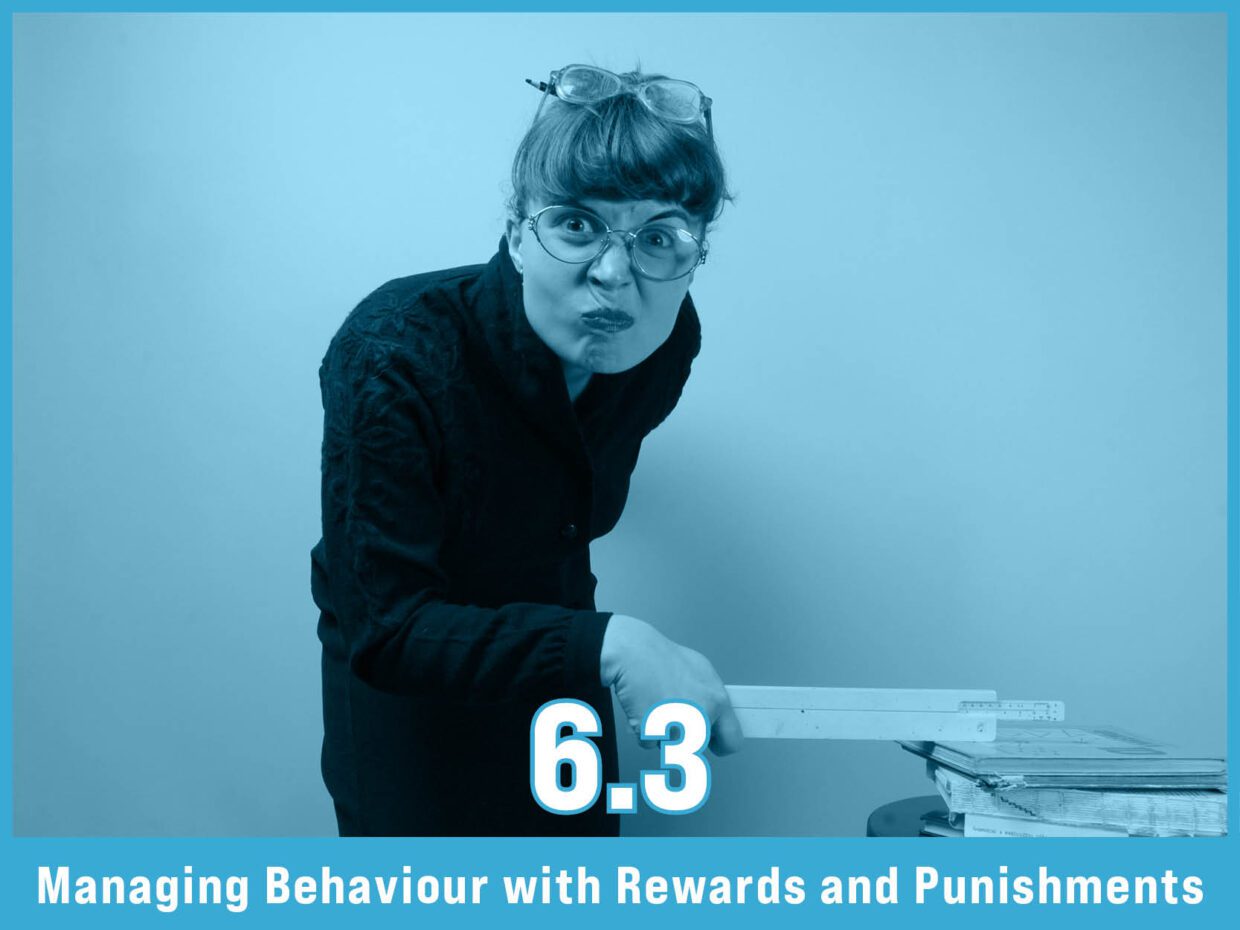
6.3 | Managing Behaviour with Rewards and Punishments
Preview
Before we begin, look at this list of possible responses to misbehaviour. Which do you think are acceptable, and why? When you have finished, click below to see some thoughts about each:
- Clean the bathrooms.
- Lose five points.
- Stand on one leg for ten minutes.
- Stand up and apologise to the class.
- No recess.
- A public reminder of the rules.
- Do extra homework.
- The whole class must work in silence.
- Sit in the corner and face the wall.
- Three beatings with a stick.
Click to reveal some thoughts about each punishment
Thoughts about each punishment:
- Clean the bathrooms – Possibly, it depends on the program. You should not give students unnecessarily humiliating, dirty or degrading punishments.
- Lose five points – Probably.
- Stand on one leg for ten minutes – Unlikely. This is a physical punishment and therefore is probably unacceptable.
- Stand up and apologise to the class – Possibly. Be careful not to publicly humiliate any student in class.
- No recess – Possibly, but remember that students, especially younger students, need exercise, fresh air and a change of environment.
- A public reminder of the rules – Probably. Be careful not to publicly humiliate any student in class.
- Do extra homework – Probably. However, be mindful of fairness and students’ existing workload.
- The whole class must work in silence – Possibly. However, be mindful of discouraging students from expressing themselves and using their energy constructively.
- Sit in the corner and face the wall – Unlikely. This seems like an unfair and humiliating punishment.
- Three beatings with a stick – Absolutely not. Physical punishments such as beatings are cruel, and possibly also illegal.
Understanding Rewards and Punishments
Following rules and breaking rules both should have consequences. Consequences are used to impact the student’s behaviour. Depending on whether students follow or break the rules, consequences can be good (rewards) or bad (punishments). If students are behaving well, the teacher might want to reward them so that they continue that behaviour. If students are misbehaving, the teacher will need to punish them so that the misbehaviour does not reoccur. Increasing a desired behaviour requires rewards and decreasing an undesired behaviour requires punishment.
The goal of punishment is to reduce the frequency of misbehaviour. Punishment should not intentionally embarrass students, should not physically harm students and should not take away their opportunity to learn. Punishments involve giving something that is undesirable or taking away something that is desirable. For example, if a student breaks a rule, they have to write an apology to their teacher. The students do not want to write the apology so they avoid the misbehaviour. Or if a student breaks a rule, they have to eat their lunch by themselves silently in the classroom. The students want to eat lunch with their friends so they avoid the misbehaviour.
The goal of rewards is to increase the frequency of good behaviour. Rewards should be genuine and meaningful to the students. Reward involves giving something that is desirable or taking away something that is undesirable. For example, if students do not break any rules for an entire week, they get to watch a movie on Friday afternoon. The students want to watch the movie so they behave well. Or if a student works well in their group, they do not need to do homework. The students do not want to do homework so they behave well.
Students must know what the possible consequences are for their behaviour. In general, rewards are more effective than punishment. Rules may also require reminders, so that students remain aware of the consequences.